
Why Every Junior Golfer Should Consider 3D Motion Capture
Every young golfer wants to hit the ball farther, play more consistently, and build a swing that lasts. But all of that starts with how their body moves. The golf swing is a complex and powerful motion, and no two athletes move exactly the same way. That’s where 3D motion capture comes in — it reveals what’s really happening beneath the surface, giving players and coaches the kind of insight that video alone can’t provide.
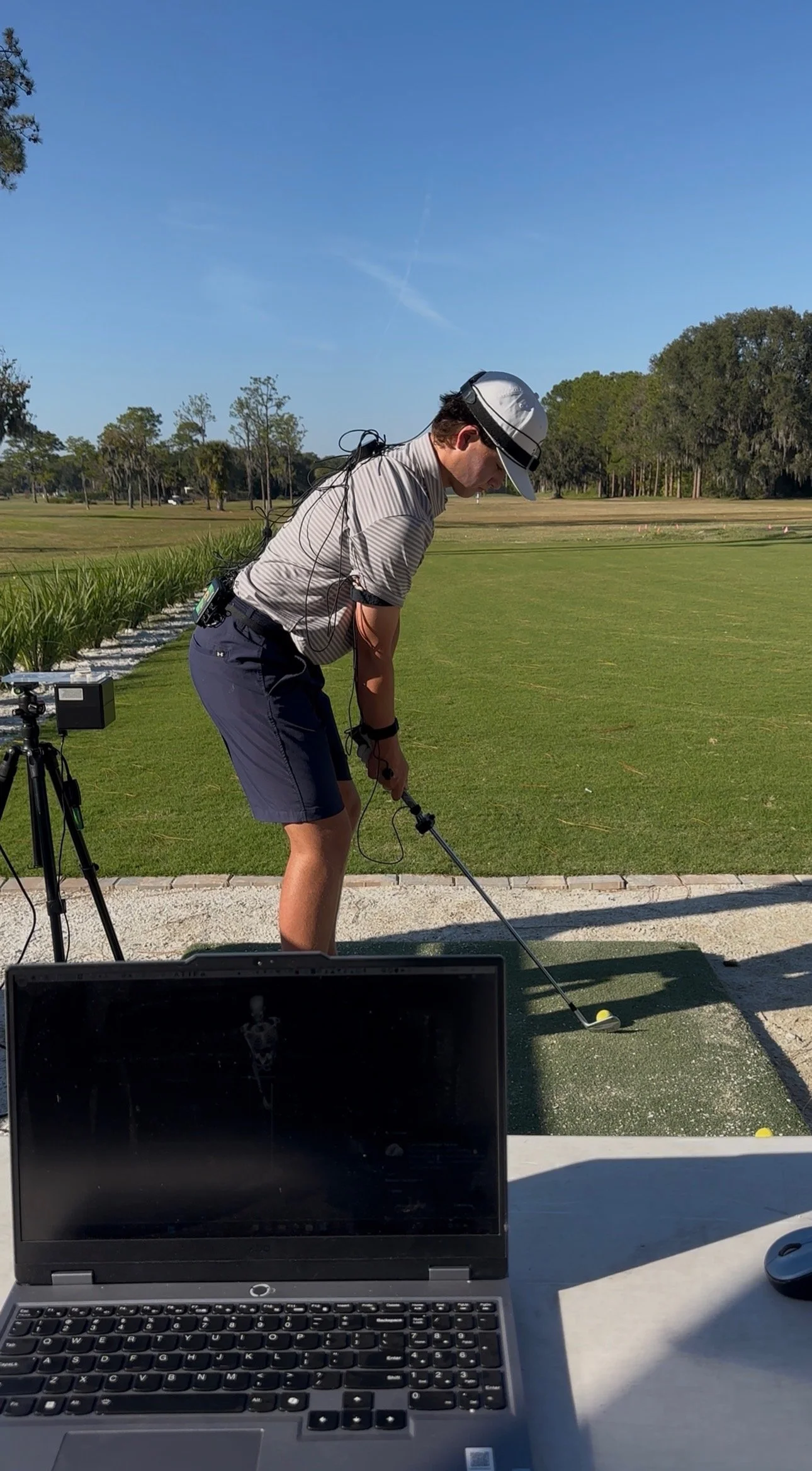
Matt Simpson during an MMG off season training week
1. It’s the Ethical Approach to Long-Term Development
The golf swing is one of the most powerful movements in all of sports. A young athlete’s body is exposed to tremendous rotational forces and speed, and if those forces aren’t aligned with their anatomy, the risks of pain or injury go up dramatically.
3D motion capture allows us to see how each joint is moving — where there may be excess stress, high ranges at high speeds, or positions that simply aren’t sustainable over time. Identifying these “red flags” early means we can guide players toward movements that protect their health while still allowing them to perform at a high level. In short, it’s just the right thing to do.
2. It Unlocks True Performance Improvement
When we capture a player’s swing in 3D, there’s no guessing. We can see dominant movement patterns, understand why the body is moving the way it does, and build a plan that’s both targeted and measurable.
This technology helps us set priorities for improvement, track what’s working, and even capture valuable data when a player is performing well and pain-free — giving us a benchmark to refer back to later. As players learn to move more efficiently, the results tend to be very clear: more consistency, more speed, and a swing that’s built to last.
3. It Provides Clear, Quantifiable Feedback
As a coach, I value accountability — for myself and my players. 3D motion capture gives us an objective way to measure progress. We can clearly see whether a player’s movement is improving and to what degree.
This clarity keeps the process honest. If the drills and strategies we’re using are producing change, we’ll see it in the data. If not, we adjust. That kind of measurable feedback fosters trust between coach and player and helps keep everyone focused on the goal: steady, confident improvement.
In Closing
3D motion capture isn’t just a technology upgrade — it’s a smarter, safer, and more effective way to train.
For junior golfers serious about their development, it’s one of the most valuable tools available today.
We use 3D motion capture in our College Prep Full-Time program because it reflects what we value most: health, performance, and opportunity. It helps us protect young players’ bodies, enhance how they move, and give them access to the same level of insight and technology used by top professionals. Our goal is simple — to provide every junior golfer the tools and knowledge they need to excel in the game, both now and for the long haul.
Written by MMG Owner Ian Mellor
Ian is a specialist in movement in the golf swing, he has been using 3D motion capture in player development since 2014. He has a bachelors in Sports Science, including education in advanced biomechanics as well as spending hundreds of hours with leading doctors in the world of golf. He has worked with PGA Tour players, LPGA Tour players and has coached 4 National Amateur Champions.